


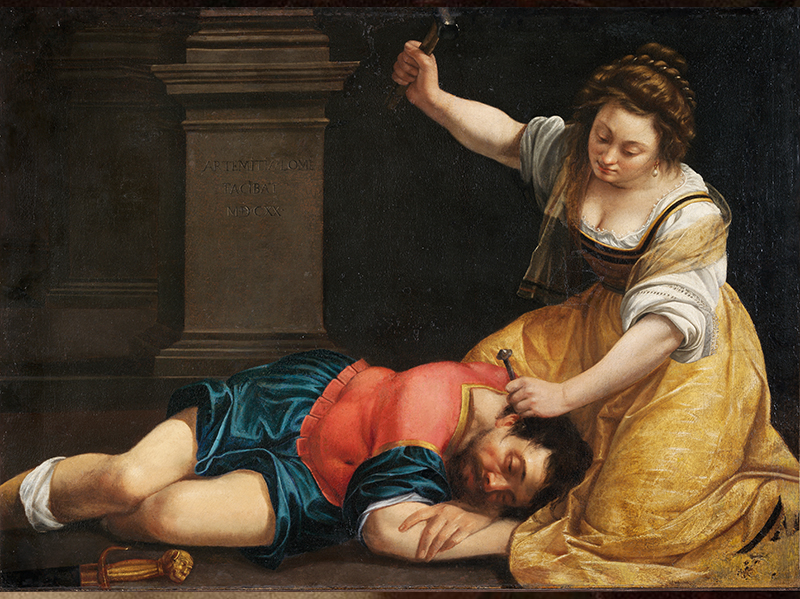
From 26 September 2021 to 23 January 2022, Rijksmuseum Twenthe presented a spectacular exhibition on the life and work of Baroque painter Artemisia Gentileschi (1593–after 1654). One of the most important figures in seventeenth-century Italian painting, she was so renowned that her first name alone was enough – and still is: Artemisia.
As a woman, she asserted herself in a male-dominated world without conforming. For this reason, she would later become a symbol of resistance against the patriarchy.
Artemisia – who didn’t come across her name in newspapers, magazines or reviews over the past year, following the major retrospective in London? Her extraordinary talent was described in superlatives. “A sort of proto-feminist heroine, the queen bee of female empowerment: the Beyoncé, if you like, of art history,” wrote The Telegraph.
This comment immediately reveals Artemisia’s uniqueness. She is a painter, a woman, a great artist, a rare talent – not in spite of being a woman, but because of it. She uses her own image, her own body, mastering it as a language. In doing so, Artemisia claims a place in the history of women. She relates to the great women of the past she painted, as well as to the generations who would later see her as a symbol in the fight against the patriarchy.
This perspective – Artemisia in the history of women, rather than a woman in a male-dominated world – is the deliberate and wholehearted curatorial approach taken by Rijksmuseum Twenthe in the exhibition Artemisia. Women & Power.

A unique exhibition
Artemisia – the artist whose work and personality recently gained phenomenal attention through glowing reviews of her retrospective in London – is coming to the Netherlands. With around twenty paintings by Artemisia and another twenty works by her Baroque (male) contemporaries, Rijksmuseum Twenthe will present the spectacular work of Artemisia from 26 September 2021 to 23 January 2022, in collaboration with Davide Sandrini (StArt). Never before has such a large selection of Artemisia’s paintings been shown in the Netherlands. A unique moment, a unique perspective, a unique exhibition.
Artemisia. Women & Power
The exhibition Artemisia. Women & Power centres on the extraordinary life and work of Artemisia. The project is part of a recent “rediscovery” of the artist – a female icon, a painter’s daughter, an exceptional (portrait) painter who led a remarkable life. Artemisia’s restlessness and financial struggles, her break with her father and his studio, motherhood and the loss of her children, her international patrons and reputation in a male-dominated world, the cultural networks she moved in and her handling of her own body – these biographical aspects offer a compelling lens through which to view her oeuvre. Rijksmuseum Twenthe presents powerful portraits: quintessentially Baroque, sensuous, at times bordering on scandal, a mix of violence and seduction.
But this exhibition is not only about the interplay between life and work. It also explores the parallels and contrasts between Artemisia’s world and our own. Artemisia is a gifted painter, a woman, a symbol. What do her biography and paintings reveal about her own time, and what does our understanding of her say about ours? How can we read her paintings today?
Artemisia, a woman in the Baroque
To highlight the distinctive, individual voice in Artemisia’s work, her paintings are shown alongside those of gifted artists from the same extraordinary artistic period: the Baroque. Through comparison and contrast, Rijksmuseum Twenthe demonstrates how Artemisia’s identity as a woman is expressed in her art – next to the work of male contemporaries who often shared her seductive visual language, and whom Artemisia likely knew, personally or by reputation.


