


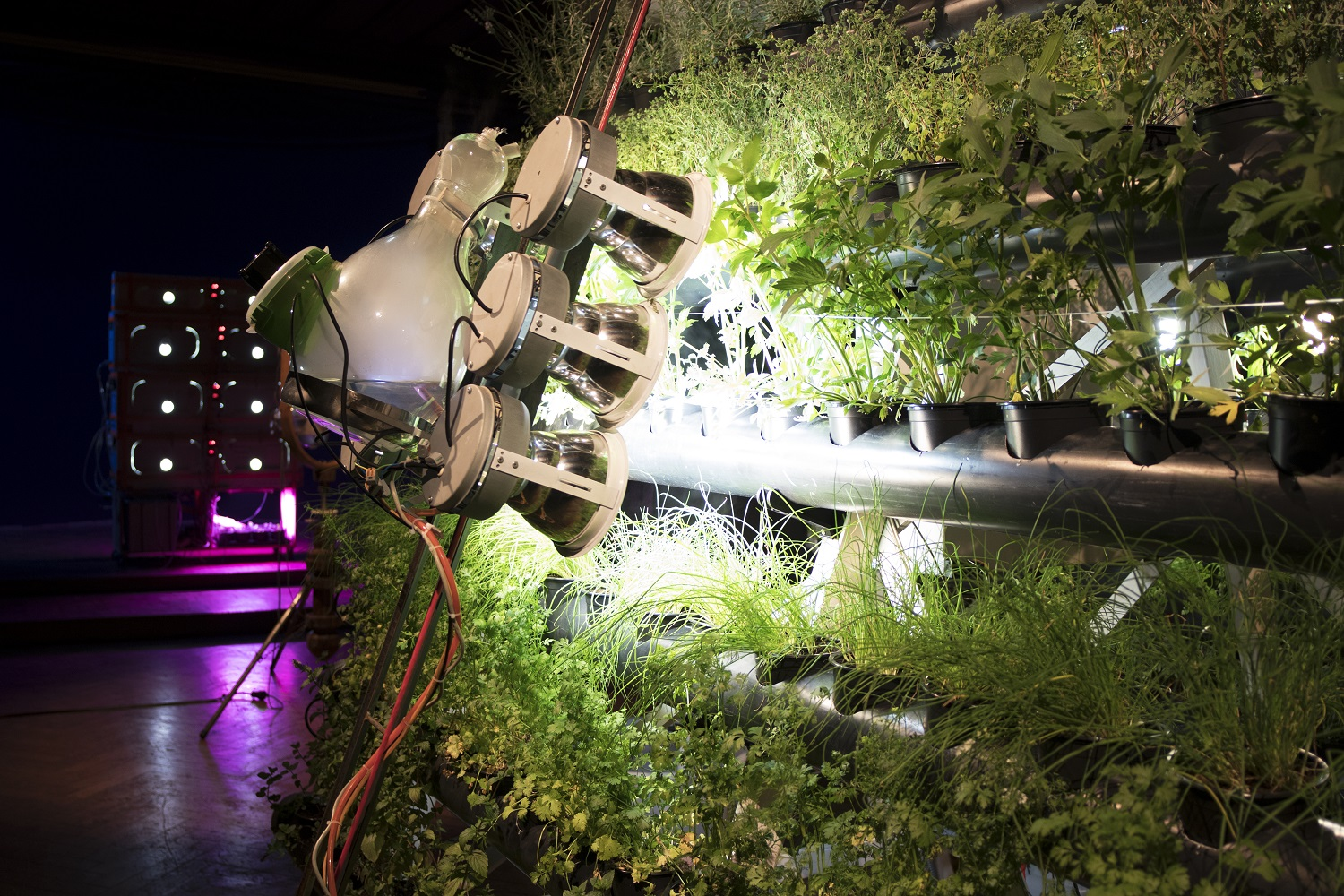
In 2021, Christiaan Zwanikken became the second artist to take up residence in Het Groene Lab, the green workspace of Rijksmuseum Twenthe. Zwanikken is known for his kinetic sculptures, where human, animal, and machine merge into one. In recent years, his interest in the botanical world has become increasingly prominent in his work. This has resulted in multisensory installations that place both the study of plants and the plants themselves at the center.
Zwanikken has always had a keen interest in the plant world and biodiversity. From the very beginning of his artistic career, the relationship between humans and their natural and technological environments has played a central role in his work. In recent years, however, plants have become an explicit subject of research. While exploring the natural reserve surrounding his studio in Portugal, he discovered a rare species of lavender, which he began to study and propagate. Zwanikken became increasingly fascinated by what he calls the “superior sensoriality” of plants—their ability to respond to their surroundings and to communicate with one another through complex chemical and biological processes. His installations function both as observatories in which these processes are explored, and as artistic outcomes of that ongoing investigation.
Sensory Installations
Technology plays a crucial role in Zwanikken’s practice. In his recent works, he uses it to make the hidden qualities of plants—often imperceptible to us—tangible and experiential. A striking example is the installation Nose Patrol, consisting of two kinetic sculptures that function like cannons, emitting aromatic clouds that are visible, audible, and tactile. The scents are created using natural plant substances such as essential oils, hydrosols, and tinctures, all produced by the artist himself. In this way, Zwanikken invites the public to experience the intensity of natural fragrances through multiple senses.


Conceptual Starting Point
The starting point of Zwanikken’s latest work is the assumption that human activities causing climate change and biodiversity loss are symptoms of a larger problem regarding how we experience the world. As technology increasingly penetrates our lives, the role of sensitive experience of the environment diminishes. According to Zwanikken, without empathy for biodiversity, it becomes practically impossible to build the stable psychological foundation needed to solve the current environmental crises. Reconnecting the creativity of the human mind with the intelligence of biodiversity is the only way to restore balance between humans and other life forms, according to Zwanikken.
The Green Lab
Christiaan Zwanikken’s project takes place both inside and outside the museum walls. In the inner garden of RMT, which was transformed last year into a green workspace for artists and the public, he will establish a trial field with a rare lavender species he discovered around his Portuguese studio. This eccentric lavender plant has a spicy scent, a unique way of growing, and special chemical properties. For these reasons, the plant is an important ingredient for Zwanikken’s work, including the aforementioned scent cannons. Inside the museum itself, the exhibition Sheer Seeds and Monochrome Instability is on display, featuring several recent installations and sculptures, as well as a new work titled Hypergravity Bio Portal developed especially for this project.


