


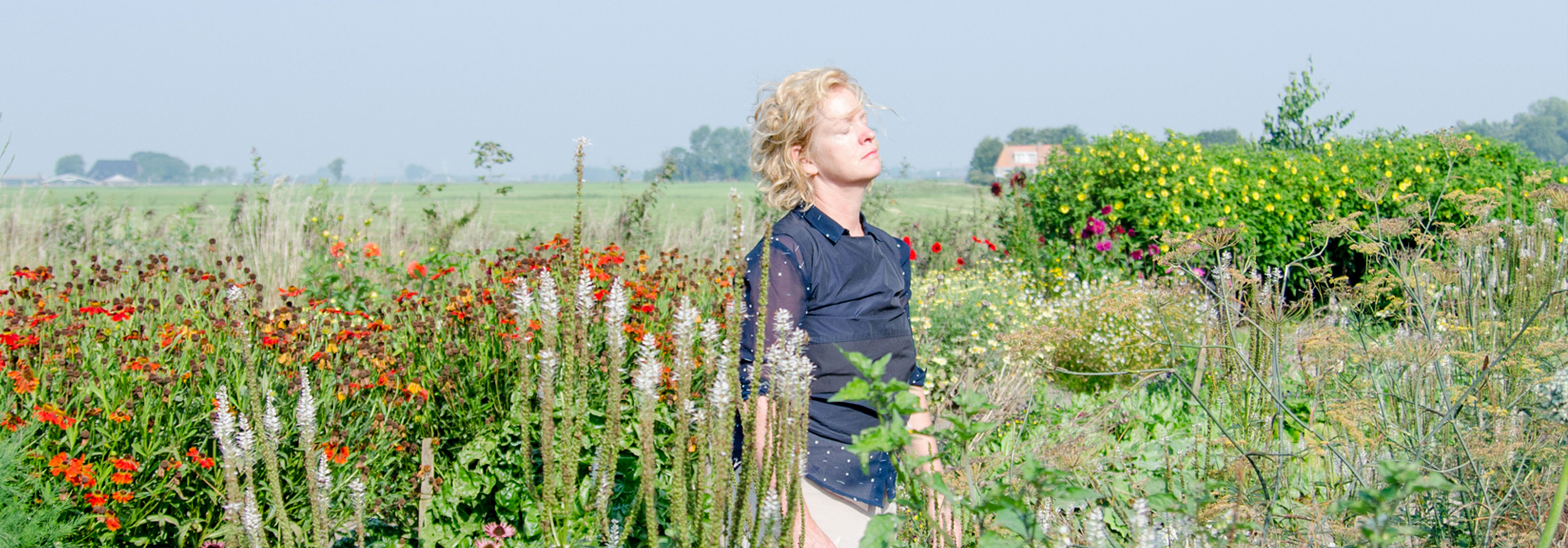
In the summer of 2020, Claudy Jongstra made the vitality and natural energy of herbs and plants visible. Under the title Inner Vitality, she created a new garden and a mesmerizing spatial installation of over 400 m² for Rijksmuseum Twenthe. Nature is, in a literal sense, both nourishment and inspiration for Jongstra’s work. The herbs and plants in the new museum garden were used by Jongstra in the creation of the installation.
Experimental Installation
Claudy Jongstra (1963) is internationally renowned for her monumental tapestries and architectural installations made of felted wool dyed with natural pigments. At Rijksmuseum Twenthe, she takes a new direction by presenting an experimental installation focused on exploring the inner vitality of plants and herbs. For this, Jongstra uses so-called “stijgbeelden”—a technique that translates the life force of crops into enchanting visual patterns. Like a contemporary alchemist, she poetically reveals the vital importance of healthy soil life for everything that grows.

Inner Vitality Garden
In addition to the installation, Claudy Jongstra designed a section of the new courtyard garden at Rijksmuseum Twenthe. Under the direction of Lodewijk Baljon Landscape Architects, the garden has recently been transformed from a formal, paved space into a green workspace, where botanical materials such as flowers, plants, and trees take center stage. Claudy Jongstra is the first artist to work in this so-called “Green Lab” and developed the planting plan for several of its beds. Her sections of the garden feature the herbs and plants used in the installation, as well as the flowers and dye plants she uses to color her tapestries.
Monumental Tapestries
Alongside the garden and spatial installation, Jongstra presents both existing and new works throughout the museum. She is currently developing a permanent artwork for the entrance hall, titled Identity Diptych. This piece consists of two monumental felted wool tapestries that symbolize both the past and the future of the Twente region. The dye crops used for these tapestries also appear in the garden designed by Jongstra. Finally, several earlier works by Jongstra are on view in the museum’s permanent display, where they enter into dialogue with the museum’s collection.
Holistic Vision
What defines Claudy Jongstra’s practice is her holistic vision of being an artist. The final result and the process are equally important, with themes such as sustainability, biodiversity, and the preservation of “secret knowledge” taking center stage. Jongstra keeps her own flock of sheep, which provides the wool for her artworks, and cultivates dye plants on the land surrounding her farm in Friesland to extract natural pigments.
Transmission and education are an integral part of her artistic practice. That’s why, this summer—circumstances permitting—various workshops will be held in the museum garden, offering the public an opportunity to engage with Jongstra’s creative process.
Claudy Jongstra’s works are held in numerous private and museum collections, including those of the Stedelijk Museum Amsterdam, the Museum of Modern Art in New York, and the Victoria and Albert Museum in London.


