


- Home
- >
- En
- >
- See and do
- >
- maria blaisse - the emergence of form
Maria Blaisse
The Emergence of Form
Designer and visual artist Maria Blaisse has played a leading role in the Dutch design world for forty years. This served as the impetus for the retrospective exhibition The Emergence of Form at Rijksmuseum Twenthe, which brought together her most important works from the past four decades. This exhibition was on view from February 9 to August 17, 2014.
For forty years, Maria Blaisse has followed her own path, independent of trends, with a focus on the exploration of material and form. Nearly her entire body of work—comprising costumes, hats, boots, bags, glass, and architectural structures—is based on the shape of a rubber car inner tube. The forces and shapes generated when the rubber tube is cut open have been a source of experimentation and inspiration for Blaisse for many years. Whatever material she works with—rubber, foam, textile, silver, or glass—she consistently discovers the same formal principles.
Quest for Form
In her work, Blaisse pays little attention to the boundaries between design, visual art, architecture, dance, and fashion. She developed a C-shaped boot (the C-Shoe) for the shoe brand Camper and created costumes for singer and dancer Paula Abdul’s Vibeology world tour. Despite their differences in material and appearance, all these creations trace back to the basic shape of a round inner tube.
Bamboo Structures
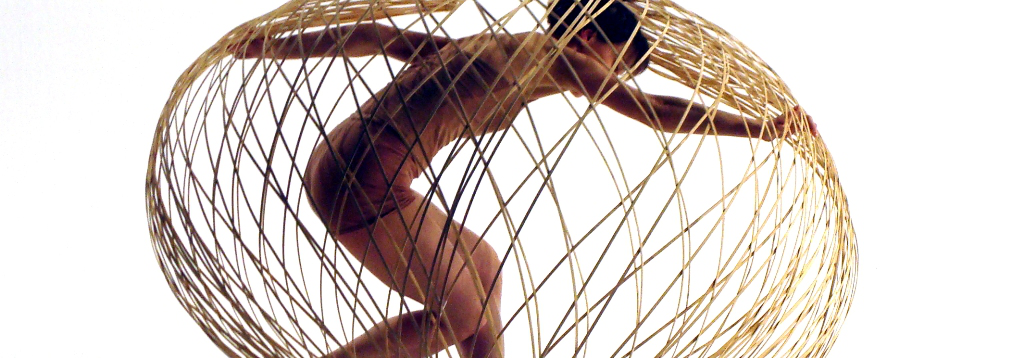
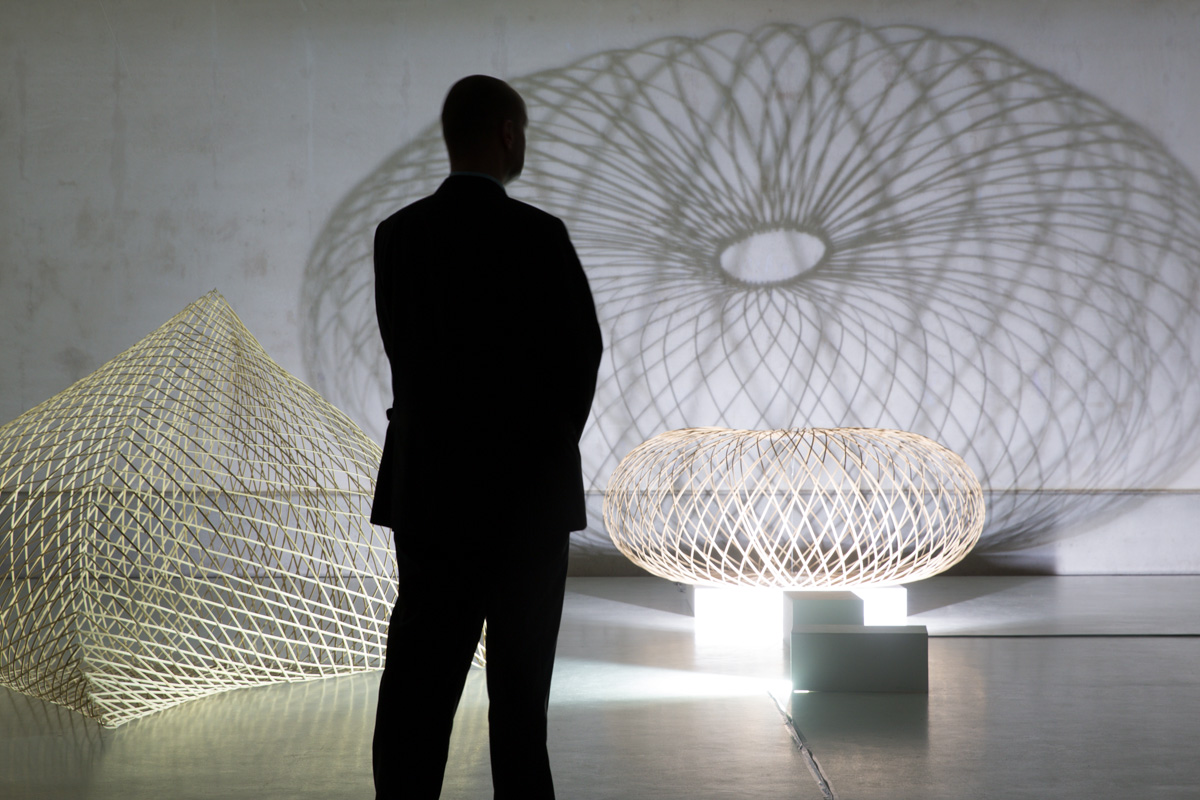
In recent years, Blaisse has also experimented with bamboo. She developed several spatial structures made of woven bamboo, which again refer back to various primordial forms, including the round tube. Some of these structures are animated, appearing to breathe. Others are used by dancers in performances that transform the structures from one form to another. In both cases, the results are poetic and enchanting.
Exhibition
The exhibition Maria Blaisse. The Emergence of Form featured some of the large bamboo structures as well as videos of performances bringing these structures to life. Costumes that had not been seen for years were also shown, alongside smaller works in rubber, glass, textile, and silver.


