


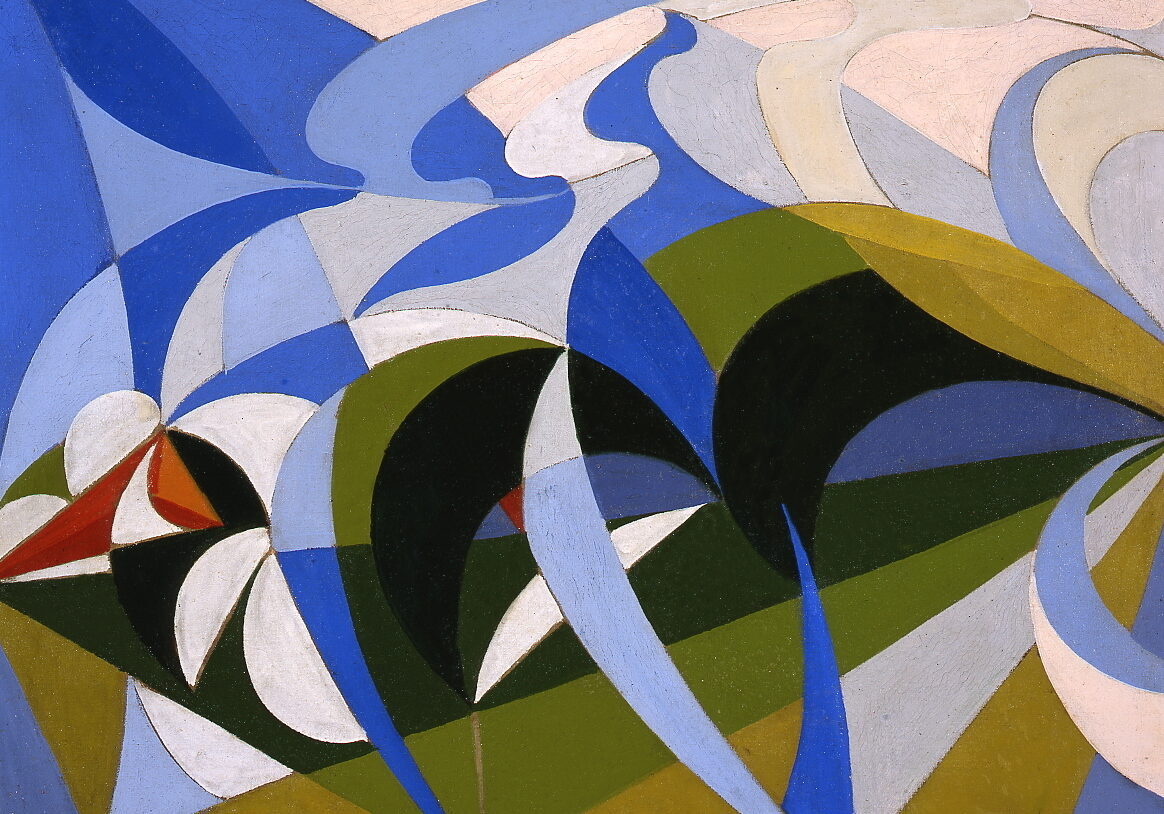
On February 20, 1909, the Italian poet Filippo Tommaso Marinetti ushered in a new artistic era with his Futurist manifesto published in the French newspaper Le Figaro. In the manifesto, he celebrated speed, the future, aggression, and activism, while firmly rejecting the past. These energetic principles resonated with many young artists and intellectuals, quickly gathering a group of young Futurists around him. In the three decades that followed, the Futurists used their imagination to shape a radically new future.
Much more than today, art and politics were deeply intertwined in the early decades of the twentieth century. They attracted and repelled each other, a dynamic visible in countries like Germany, Russia, and also Italy. Within the avant-garde ideology, we find an optimistic idealism where artists dreamed of a new world.
Today, Futurism is not only seen as an artistic avant-garde but, for many, is inseparably linked to fascism. Marinetti is often regarded as a follower of Mussolini. However, looking back on his life reveals the story of a man navigating between his ideals and reality. To keep his beloved Futurist movement alive, he maneuvered between fascism and his own revolutionary ideals—sometimes openly for or against, but often pragmatically searching for the right path toward his envisioned new world, which in reality proved far more complex than he had imagined.
Contradictions
The political circumstances forced Futurism to continually reinvent itself, with all the artistic consequences that entailed. This made the life of Marinetti and the avant-garde Futurism complex, sometimes ambiguous, and often paradoxical. Was Futurism a progressive and utopian ideology, or merely crude propaganda for a fascist regime, dressed in modernist formal language? It is precisely these contradictions in Marinetti’s life that make Futurism so fascinating.
The Evolution of Futurism
The exhibition traces the evolution of Italian Futurism through works by the ‘first generation’ Futurists—Gino Severini, Umberto Boccioni, Giacomo Balla—as well as later Futurists like Roberto Marcello Baldessari, Fortunato Depero, Tato, and Benedetta. Richly supplemented with texts and documentary material, Rijksmuseum Twenthe presents Futurism as a manifesto for a new world.


Publication
Accompanying Marinetti and Futurism: Manifesto for a New World is a richly illustrated publication that delves deeply into the artistic and social developments in Italy from 1909 until the end of World War II. The book is published by Waanders Uitgeverij and is available for €23.95.
The exhibition Marinetti and Futurism: Manifesto for a New World is made possible with financial support from the Istituto Italiano di Cultura di Amsterdam, the Ministry of Education, Culture and Science (OCW), the Province of Overijssel, the Municipality of Enschede, the Patrons of Rijksmuseum Twenthe, Friends of Rijksmuseum Twenthe, and the GJ van Heek Junior Fund.
Exhibition under the curatorship of Rijksmuseum Twenthe and organized by StArt.
Photo credits: Lotte Stekelenburg


