


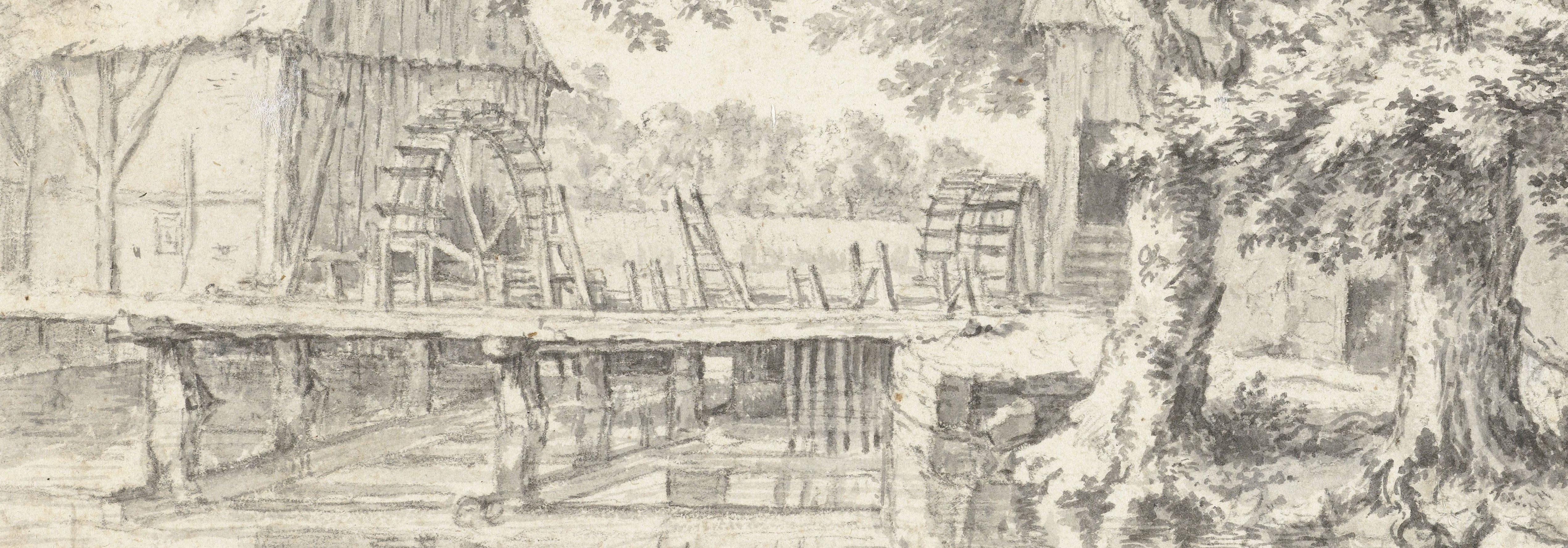
The rolling landscape of Twente has been a source of inspiration for many artists since the 17th and 18th centuries. Painters such as Jacob van Ruisdael, Meindert Hobbema, and Anthonie van Waterloo traveled through Twente on their way to Bentheim, capturing the landscapes they encountered along the way. They were fascinated by the half-timbered houses, watermills, castles, and estates—many of which can still be seen in the local countryside today.
The exhibition On the Way to Bentheim presents over 35 works showing Twente through the eyes of Ruisdael, Hobbema, Waterloo, and many other artists of the time.
Twente as a source of inspiration
In 1604, the Haarlem painter and art theorist Karel van Mander encouraged young artists in his well-known Schilder-boeck to leave the city and observe the landscape. According to him, painters should make drawings on site and later develop these into paintings in their studios. This advice was followed by many young landscape artists throughout the seventeenth century. In search of suitable, picturesque motifs, they traveled across the country from various cities, looking for sweeping vistas, river landscapes, and forests.


The province of Overijssel, the Twente region, and the Dutch-German border were also among the destinations of landscape artists. Such journeys must have been difficult. Highwaymen were a known threat, and the roads were muddy and poorly maintained. We know this in part thanks to a travel account of Cosimo de’ Medici, Grand Duke of Tuscany, who visited the region in 1668. His biographers wrote that the roads in Twente were hard to traverse, the inns uncomfortable, and that large manure heaps were piled in front of city farmhouses.
Nonetheless, artists such as Jacob van Ruisdael, Nicolaes Berchem, and Meindert Hobbema chose the Dutch-German border region as a source of inspiration. Ruisdael painted Castle Bentheim multiple times—located just ten kilometers across the border from Oldenzaal—as well as the watermills at Singraven and a view of Ootmarsum. He also made drawings of the landscape. For instance, he appears to have sketched the double watermill at Huis Singraven on several occasions and drew the half-timbered houses he encountered along the way.
Drawing Journeys in the Eighteenth Century
Half a century after Ruisdael, artists were still traveling to the eastern part of the Netherlands. Among them was Cornelis Pronk, who, together with Abraham de Haen (II) and Andries Schoemaker, journeyed through Overijssel in 1732 to document the country estates in the region. Together, they captured clearly recognizable landmarks of Twente. These drawings depict manor houses and estates that still exist today and were later compiled in the Atlas Schoemaker. The works of Pronk and De Haen are remarkable documents that vividly portray the Twente region in the eighteenth century.
About the Exhibition
The seventeenth-century drawings of the Twente landscape show how, even at that time, artists—sometimes working en plein air, sometimes on a large scale—chose the world around them as their subject, capturing the rolling, wooded landscape in their artworks. The exhibition also illustrates how the Twente landscape continues to inspire artists in both drawing and painting, long after their initial visit.
The exhibition is a collaboration between Rijksmuseum Twenthe and the RKD – Netherlands Institute for Art History. The works on display range from small sketchbooks to large-scale drawings and landscape paintings.
Sketching to Bentheim
A special sketchbook has been designed for both adults and children, filled with fun drawing and observation exercises that can be done both in the exhibition and outdoors. The sketchbook is available in the museum shop for €2 (including two drawing pencils).
Cycling Route: Travelling with Ruisdael
In collaboration with Landschap Overijssel, a cycling route has been created along several beautiful locations that appear in the artworks on display. The route is available at the museum.


