


A Paradox
The term Golden Age is usually applied in retrospect — to a moment in history when something extraordinary took place. Such ages are often declared in times of uncertainty, when a nation seeks unity, identity, and a proud story from the past to hold onto. But in the case of the Danish Golden Age — which lasted not a full century but roughly half — something remarkable occurred.
The early 19th century was anything but golden for Denmark. A fading world power, the country suffered humiliating military defeats, lost nearly its entire navy, ceded Norway, saw its monarchy weaken, and declared national bankruptcy. Denmark was a nation on the brink. And yet, this is the era proudly marked as its Golden Age.
Repair Through Imagination
The Danish Golden Age wasn’t a nostalgic look back, but an act of cultural repair through imagination. From the ashes of crisis, art, literature, and science rose to guide the nation forward. Philosopher Søren Kierkegaard laid the foundation for modern existentialism. Author Hans Christian Andersen became a literary icon. Scientist Hans Christian Ørsted discovered electromagnetism.
National Sentiment
Painting also played a central role. At its heart stood Christoffer Wilhelm Eckersberg, who, after achieving success abroad, returned to Denmark with a renewed national focus. Like many European countries at the time, Denmark turned inward: the once multilingual and multicultural society became increasingly nationalistic. Artists were now judged by their origins and by how well their work reinforced the emerging national identity. This national sentiment found expression in painting, with motifs that emphasized Denmark’s ‘authentic’ character.
Pride and Ideal
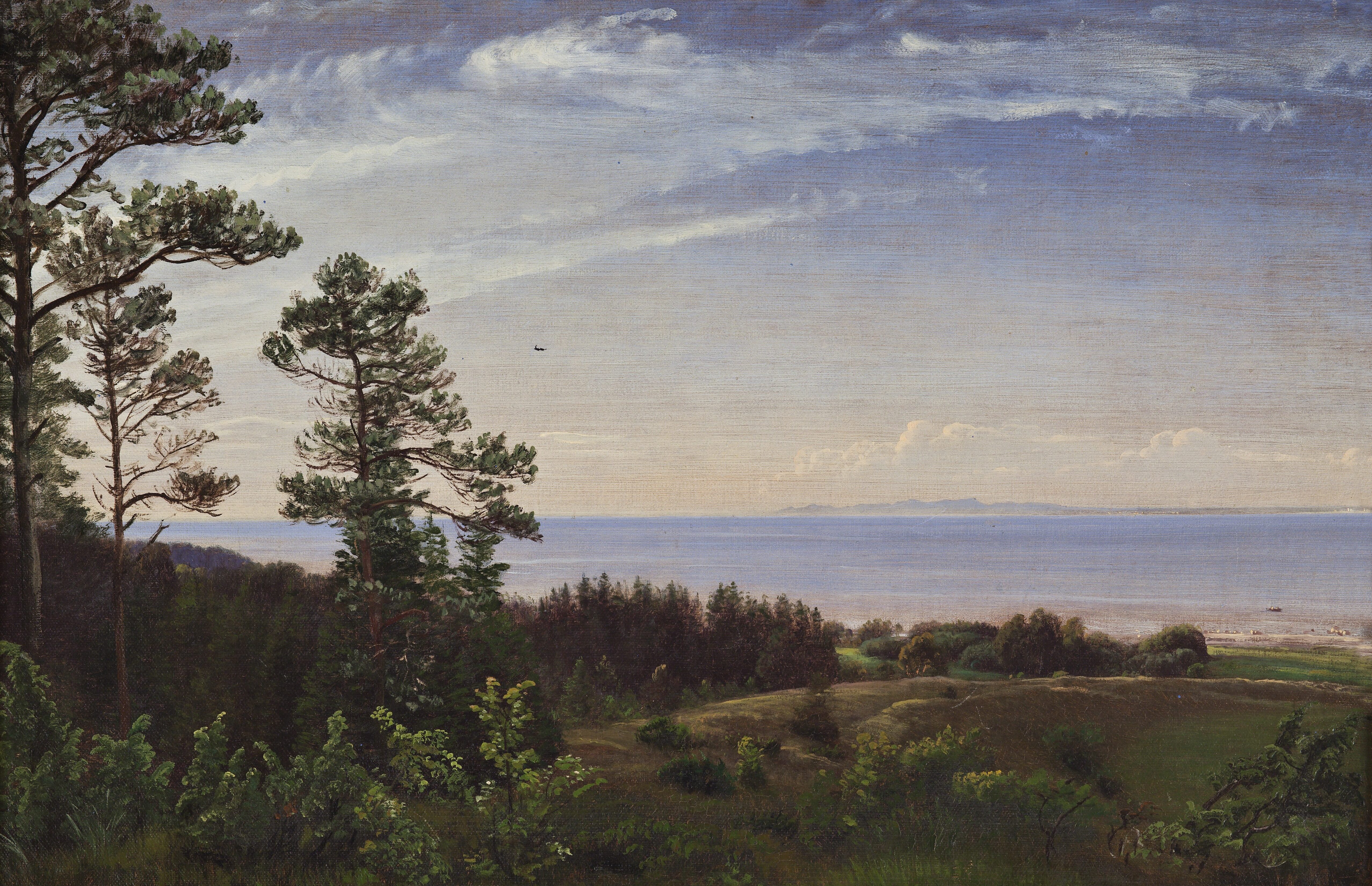
While Eckersberg and younger painters like Christen Købke, Martinus Rørbye, and Thomas Lundbye drew inspiration from abroad — Italy was especially popular — they increasingly focused on Danish themes. A new navy ship, painted after the fleet’s loss, could inspire hope. Rolling Jutland fields and the chalk cliffs of Stevns became as picturesque as any foreign landscape, symbolizing a quiet Danish identity. Rural idylls, painted with romantic simplicity, idealized the modest life of the Danish countryside. This new art aligned with a rising middle-class audience and helped shape the nation’s self-image.
But the Danish Golden Age was more than a local affair. It marked a turning point in Europe’s cultural landscape. Blending the international neoclassicism of the 18th century with the inward-looking Romanticism of the 19th, Danish painters created a forward-looking art — a form of idealized realism that foreshadowed modernism. A unique moment in history.
The Exhibition
This exhibition at Rijksmuseum Twenthe presents over fifty works from the Nivaagaard Collection, showcasing major figures from Denmark’s artistic heyday, including Eckersberg, Købke, Rørbye, Hansen, Roed, and Marstrand, as well as younger artists such as Lundbye and Skovgaard. Together, the works offer a cross-section of Denmark’s Golden Age, and a visual insight into the paradox that defined it.
This exhibition is a collaboration with the Nivaagaard Collection, Nivå, Denmark.
The Nivaagaard Collection
Just as the influential Van Heek textile family laid the foundations for Rijksmuseum Twenthe in the early 20th century, Danish industrialist and politician Johannes Hage established the Nivaagaard Collection in 1908. In the town of Nivå, north of Copenhagen, he presented his personal collection of masterpieces from various Golden Ages of painting: from the Italian Renaissance and the Dutch 17th century, to works by Danish artists from the early 19th century — Denmark’s Guldalder, or Golden Age, as it is known in the Netherlands.
Publication
A richly illustrated publication accompanies the exhibition, with contributions by Andrea Rygg Karberg, Birgitte von Folsach, Henk van der Liet, and Tim van Gerven. The book is published by Waanders & De Kunst, in collaboration with Rijksmuseum Twenthe.


