


- Home
- >
- En
- >
- See and do
- >
- The International Landscape
The International Landscape
Painting in the Open Air in the Nineteenth Century
From 17 February to 9 June 2024, Rijksmuseum Twenthe invited visitors on a journey through time with the exhibition The International Landscape: Painting in the Open Air in the 19th Century. The exhibition explored an era in which artists around the world embraced nature, travelled across their own countries, and searched for the extraordinary and the spectacular in the world around them.
Out into the Open
The journey begins in the nineteenth century, a period in which artists developed a new perspective on landscape painting. They began drawing and painting recognisable places. Out into the open—walking until they found a picturesque spot or were caught by a sudden thunderstorm. As the Dutch painter Willem Roelofs (1822–1897) once said, “in foul weather, nature is dearest to him.” Artists deliberately chose to depict their own landscapes—what they saw all around them. And this wasn’t just happening in the Netherlands. This development can be seen in artworks from all over the world during this period.
Artists’ Colonies and Travelling Painters
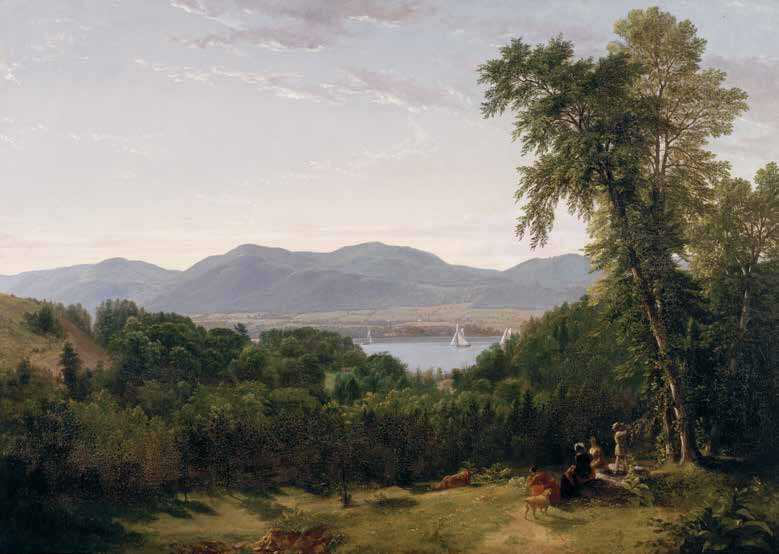
The exhibition highlights the global emergence of artists’ colonies, such as the Barbizon School, the Hague School, and the Hudson River School. Artists travelled through their native landscapes, inspired by the unique, the personal, and the undiscovered in their surroundings. In the former Russian Empire, members of the group Peredvizhniki (The Wanderers) ventured into the countryside to paint their own forests and meadows. In Japan, artists journeyed along the Tokaido—the road connecting Tokyo and Kyoto—capturing the beauty of their homeland.


Women Artists
It wasn’t only male artists who ventured outdoors. In the second half of the nineteenth century, there was a notable rise in female landscape painters. These women fought for greater freedom and joined artists' colonies, gaining access to art education and the opportunity to paint outdoors together. Marie Bilders-van Bosse sketched in the dunes near Scheveningen and painted in Oosterbeek. Betzy Akersloot-Berg, a student of Hendrik Willem Mesdag, worked on the island of Vlieland, among other places. In the United States, Susie Barstow and Julie Hart Beers joined the Hudson River School. Though they did not receive formal art training, they stood out for their contributions to art and their pursuit of freedom and equality. Discover the work of these pioneering women in this exhibition, shown alongside that of their male contemporaries.
Compare and Discover
The exhibition The International Landscape: Painting in the Open Air in the 19th Century features over 70 works from around the world, presented in a thematic display. Winter scenes, seascapes, and forest landscapes from different countries are shown side by side. This allows visitors to explore how, despite the artists’ pursuit of national identity, the works often share striking similarities. Be surprised by the unexpected connections between artists from across the globe.
Samenwerking
Voor deze tentoonstelling werkt Rijksmuseum Twenthe samen met het Ateneum, Art Museum in Helsinki en het National Museum of Estonia in Tallinn.
Ontdek daarnaast ook andere bijzondere bruiklenen uit gerenommeerde openbare collecties, waaronder het Statens Museum for Kunst in Kopenhagen, het Latvian National Museum of Art in Riga, het Museo Nacional Thyssen-Bornemisza in Madrid, het De Young Memorial Museum in San Francisco, de New York Historical Society and Museum, en de Gösta Serlachius Art Foundation in Mänttä. Deze prachtige werken zijn zelden in Nederland te zien geweest.


