


PRACTICAL INFORMATION
About the Exhibition
This exhibition is on view from 20 March to 16 August.
Accessibility
- Wheelchair accessible
- Assistance dogs are welcome
Admission
- Adults: €16.50
- Youth up to 17 years: free
- Students: free
- CJP (with valid card): €8.00
- Group rate: €14.00 (for groups of 10 or more)
Free admission for Museum Card holders, VriendenLoterij VIP Card holders, Friends of the Museum, Business Club members, Young RMT members, and members of the Rembrandt Association.
The Naked Truth tells the story of the development of the Western human from the Renaissance through to the 21st century. It is an exhibition about humanity’s drive for knowledge and self-realization—a journey that requires embracing uncertainty and doubt, while also learning to navigate the freedoms we have created for ourselves and, ultimately, their consequences.
How will humans relate to their technological inventions in the coming century? To the ecological changes they have set in motion? And how will they live alongside those who do not necessarily share their worldview?
The Naked Truth tells a story that is originally Western but now global, spanning six centuries of visual art through more than 110 works by artists such as Marina Abramović, G.H. Breitner, Berlinde de Bruyckere, Jan Sluijters, Geertgen tot Sint Jans, herman de vries, Andres Serrano, Andy Warhol, Carel Willink, and many others. In this exhibition, different art forms are not separated but complement one another. Alongside numerous drawings, paintings, and sculptures, prose and poetry are also presented.


The Naked Truth is a four-part exhibition. A tetralogy that centers on the naked human being as a metaphor for vulnerability and strength, eroticism, freedom, self-image, and self-awareness.
I From Heaven to Earth
“The invention of the skeptical individual is the most important innovation of European and Western culture,” said German philosopher Rüdiger Safranski in 2016 during a lecture in Amsterdam on European identity. “The skeptical individual is a person who dares to question and allows doubt.”
It was these very question marks that Martin Luther placed on the power of the church, leading to the Reformation. And it was the questions raised by Erasmus regarding education and development that paved the way for a society in which humans gradually detached themselves from absolute belief in God. This gave rise to the freedom to interpret religion independently, to develop oneself, and thus to take one’s own fate into one’s hands.
II I Think, Therefore I Am
The thirst for knowledge—once the very cause of Adam and Eve’s expulsion from the Biblical paradise—turns not only to the world around us but also inward, toward ourselves. “I think, therefore I am,” declared Descartes, and within these words lies the seed of the Enlightenment. Knowledge becomes the key to a newly discovered kingdom. Increasingly, reason takes precedence. The development of science, the growth of knowledge and power, and the primacy of reason ultimately lead to the democracy we know today in Europe and, more broadly, the Western world.
III The World Within Reach
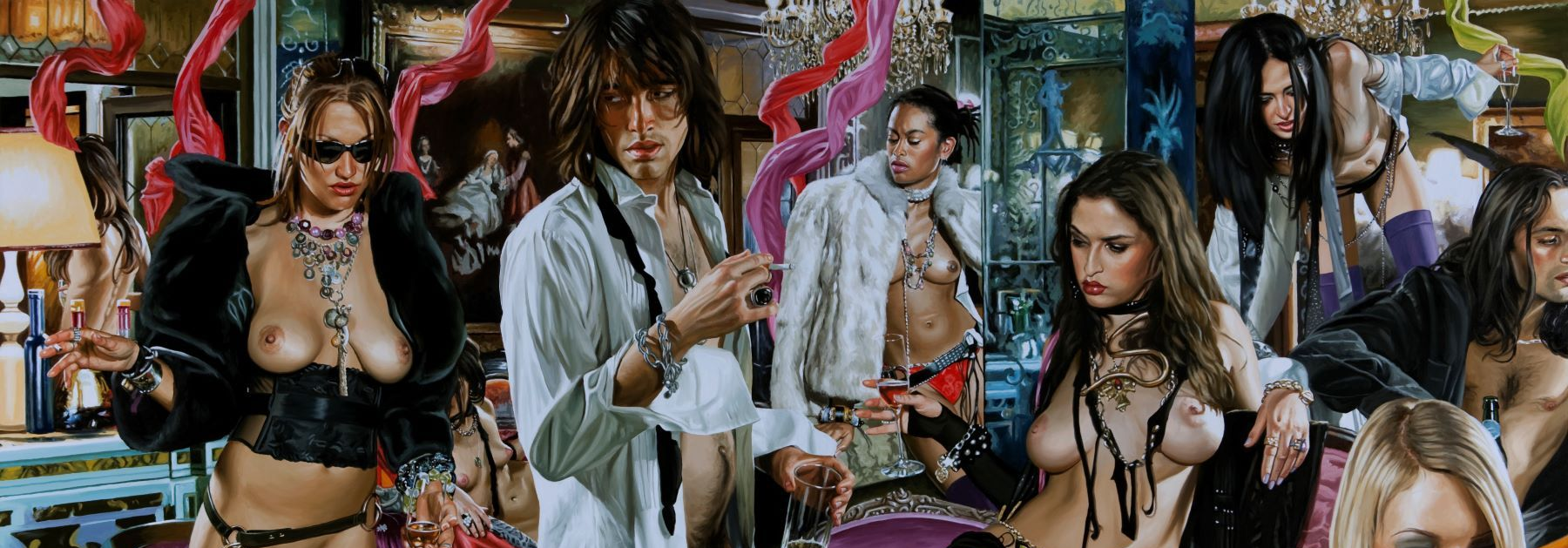
The growth of prosperity—though in some places rooted in decay—creates a society where many gain access to education and knowledge, thus opening the door to personal development. “God is dead,” Nietzsche proclaimed, and people increasingly indulge in their newfound freedom. The once heavy memento mori that shaped our lives has faded; carpe diem is now the motto. Masses pursue individual satisfaction, their rights, and their own truths. And in an ever more materialistic society, what we are worth becomes more important than who we are.
IV And Now?
The attacks of September 11, 2001, shook the Western world. Freedom, once held as the highest good, was quickly traded for another: security. The fear we thought defeated has returned. And a dawning awareness emerges that the very situations frightening us now are of our own making. Our society—more diverse than ever—calls for acknowledging both old and new mistakes, listening to different voices, and rediscovering balance.
In a time when the cards seem to be reshuffled and the once-powerful individual appears to have lost all control, the skeptical human asks anew: Who am I? And just as importantly: what now?


